
Macroeconomic data announcements, global trends and trading activity of foreign investors would guide momentum in the equity market this week, analysts said. Markets ended a five-week losing streak and gained nearly a per cent last week, helped by a sharp rebound on Friday. Last week, the BSE benchmark jumped 500.65 points or 0.77 per cent and the Nifty gained 169.5 points or 0.87 per cent.

The BRIC (Brazil, Russia, India and China) economies will continue to grow significantly even as economic giants across the world are getting affected by the recessionary fears, says a report.

The April-June quarter GDP slipped to 7 per cent from 7.5 per cent.

CLIs, which include various parameters, are designed to anticipate turning-points in economic activity relative to trend.

Modi said New Delhi has emphasised on dialogue and diplomacy along with restraint to deal with the situation arising out of the Hamas-Israel conflict.
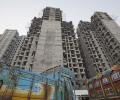
Shares of real estate firms have been outperforming over the past year. The rally, analysts say, may hit roadblocks in the near term amid stretched valuations, even as the long-term prospects for the sector remain ebullient. "Most of the positive news flow is already in the price. Hence, investors sitting on hefty profits may partially cash out at current levels," suggests V K Vijayakumar, chief investment strategist at Geojit Financial Services.
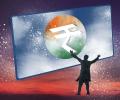
India should become a middle-income country and then push to make INR (rupee) a hard currency, and till then, it must promote the settlement of global trade in the local currency, think tank GTRI said on Sunday. Global Trade Research Initiative (GTRI) said that transforming a currency into a hard currency is a complex process that hinges on several pivotal factors. Firstly, economic stability is paramount; a country must exhibit low and stable inflation, consistent growth, and a balanced trade environment.

Vouching for preserving its independence and sovereignty, Muizzu made a firm commitment to ensure that the Maldives remains "free of any foreign military presence."

This much needed reform will also help the consumer who is hit with an eight per cent inflation in the month of August mainly for food items and we also expect to see quality improved with products delivered to the market place and the farmers getting a bigger share of the pie, INOC (I) said in its statement.
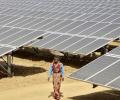
The push given to rooftop solar installation in the Interim Budget ties in with its high rate of adoption in Tier-II and -III cities of India. If original equipment manufacturers (OEMs) in the automobile industry, government, and the solar sector are to be believed, in cities of Rajasthan, Gujarat, and Kerala, 45-50 per cent of electric-vehicle (EV) users are employing rooftop power to charge their vehicles. This is compared to the national average of 25 per cent, say industry sources.

Boom, bust or a bit of both: as the jury bides time before ruling on the US 'recession', the economy's vital signs at a perplexing time of high-interest rates, still-punishing inflation, and surprisingly strong economic gains are a study of a growing debate over whether the world's largest economy is barrelling into a new downturn. With the US Federal Reserve's (Fed's) inflation fighters attempting the risky pursuit of 'pillow-soft landings' and its economy sending out mixed signals, if there is indeed a recession, it could spell trouble for domestic equities and corporate earnings growth.

She also addressed the Indian Community at a reception held in her honour in Jakarta.
Economists Maitreesh Ghatak, Parikshit Ghosh and Ashok Kotwal challenge the prevailing view that the diminished electoral prospects of the United Progressive Alliance government is the result of neglecting growth to launch populist welfare schemes. They look at a wide range of economic indicators to argue that compared to the National Democratic Alliance regime, the UPA period has been characterised by faster growth, higher savings and investment, growing foreign trade and capital inflows, and increased infrastructure spending in partnership with private capital.
'The goal is achievable. What is stopping us from getting there?' asks Aakar Patel.

India's share in world tourist inflows was only 0.64 per cent in 2012. It could only attract 6.97 million foreign tourists during 2013.
The United States has failed to make it among the world's top ten dynamic nations.

Survey calls for reorienting policies to promote young firms which have the potential to become big, rather than small MSME firms which remain small.
Prime Minister Manmohan Singh on Friday justified the decisions on allowing FDI in multi-brand retail and some other areas, saying these were aimed at pushing economic growth and generating employment in "difficult times".
Speaking at industry association CII's annual session, PM Modi said the government has taken tough steps to fight the coronavirus pandemic and has also taken care of the economy. "On the one hand we have to safe the lives of our people and on the other hand we have to stabilise the economy and speed up the economy," he said. "Yes, we will definitely get our growth back," he asserted.
In nearly 100 seats, the BJP stands almost no chance of winning. In 200 seats, it is a direct fight between the BJP and the Congress where the BJP has an upper hand. In 243 seats, the BJP is pitted against regional parties and it is not going to be easy. That is why 400 seats may end up as a pipe dream, states Ramesh Menon, author of Modi Demystified: The Making of a Prime Minister.
 © 2026 Rediff.com - Advertise with us - Disclaimer - Privacy Policy - Sitemap - Feedback - About us - Terms of use - Grievances